


A sofa that gets stuck in a doorway is one of the most common — and most avoidable — furniture delivery problems. It usually isn't the sofa's fault. It's a missing tape-measure moment: nobody checked the front door, the hallway turn, or the stairwell landing before the truck showed up. A few minutes with a tape measure before placing an order removes almost all of that risk.
This guide covers exactly what to measure, in what order, and how to compare those numbers against a sofa's listed dimensions before checkout. It also explains how Mid in Mod's delivery process is built around this exact problem, since our mid-century modern sofas ship in boxes designed to fit through tighter spaces than most traditional furniture deliveries.
The short answer: To measure a sofa for delivery, write down the sofa's four key numbers — width, depth, height, and diagonal depth — then measure the narrowest point along the delivery path (front door, hallway turns, interior doors, stairs, and elevator). The narrowest opening should be 2–3 inches wider than the sofa's width or diagonal depth. If it isn't, the sofa may still fit at an angle using the pivot method. The whole check takes about 15 minutes.
Why This Step Gets Skipped (and Why It Shouldn't)
Most sofa delivery problems come from one missed step: nobody checked the doorway, hallway turn, or stairwell before the sofa arrived. Online shopping makes it easy to fall in love with a sofa's look and scroll right past the dimensions listed further down the page. The problem only shows up on delivery day — exactly when it's most expensive to fix.
A sofa that doesn't clear a doorway usually ends in one of three ways:
- The delivery team leaves with the item, and you wait for a replacement or refund.
- A return gets initiated, often with restocking and return-shipping fees attached.
- Someone attempts a risky last-minute maneuver that can gouge a doorframe, scuff a wall, or damage the sofa itself.
None of that is necessary. A tape measure, a notepad, and about fifteen minutes solve the entire problem in advance. Measuring before you buy is the single highest-value thing you can do to guarantee a smooth delivery — and it costs nothing.
The 4 Numbers Every Sofa Buyer Should Know
Every sofa purchase depends on four measurements: width, depth, height, and diagonal depth. Gather all four from the product page before you measure a single doorway. Most listings label them clearly, but if a page only shows overall length and depth, double-check that cushion height and diagonal depth are included too.
| Measurement | What it means |
|---|---|
| Width (W) | Arm-to-arm distance across the front of the sofa — usually the longest measurement on a standard sofa. |
| Depth (D) | Front-to-back distance, from the front of the seat cushion to the back of the frame. |
| Height (H) | Floor to the highest point, typically the top of the back cushions. |
| Diagonal Depth (DD) | The distance from the bottom front corner to the top back corner when the sofa is tilted on an angle — the number that matters most for tight doorways. |

What is diagonal depth, and why does it matter most?
Diagonal depth is the measurement buyers overlook most often, and it's the one delivery teams rely on when a sofa won't fit through a doorway straight on. Tilting a sofa diagonally — often called "the pivot method" — lets it pass through openings that are narrower than its listed width, as long as there's enough diagonal clearance and enough ceiling height to angle it through.
Here's the practical takeaway: your doorway does not have to be wider than the sofa's width. It has to be wider than the sofa's diagonal depth. That single fact is why many sofas that look "too big" on paper glide through a standard 32-inch door without drama.
To measure diagonal depth yourself on a sofa you already own, place a straightedge from the highest point on the back frame to the front of the arm, then measure the distance from that straightedge down to the lowest back corner. On a product page, look for it listed as "diagonal depth" or "DD."
What You'll Need
Before you start, grab:
- A retractable tape measure (25 ft is plenty)
- A notepad or phone to record each number
- Painter's tape for the floor-footprint test (more on that below)
- The sofa's spec sheet open on your phone, with all four numbers written down
That's the entire toolkit. No special equipment, no second person required for the measuring itself.
Step 1: Measure the Path, Not Just the Room
The delivery path matters more than the room itself. A sofa that fits your living room perfectly is irrelevant if it can't get past the front hallway. Every point along that path needs its own measurement, taken in the order the sofa will actually travel.
Front door. Open it fully and measure the clear opening — from the outer edge of the door to the inner edge of the frame, not the frame-to-frame measurement. Account for door hinges, weatherstripping, or a storm door that might reduce the usable width.
Hallways and turns. Walk the exact route from the entrance to the final placement spot and measure the narrowest point along the way, including any 90-degree turns. A hallway can be wide enough on a straight run and still too tight where it turns a corner.
Interior doors. Measure any door the sofa passes through on the way to its room, the same way as the front door — actual clear opening, not the frame size.
Stairs and landings. For homes with stairs, measure the staircase width at its narrowest point, the ceiling height above each step, and the landing space where the sofa may need to pivot. Tight turns and low ceilings over stairwells are consistently the hardest spots for delivery teams to navigate — often harder than the front door itself.
Elevators. In apartment and condo buildings, measure both the elevator's interior dimensions and its door opening separately, since the opening is frequently narrower than the cabin. Confirm the weight limit and reserve elevator access with building management ahead of the delivery date.
Step 2: Compare the Numbers Before Ordering
Once every measurement along the path is written down, compare each one to the sofa's width, depth, height, and diagonal depth:
- The narrowest point in the path should be greater than the sofa's width or diagonal depth — ideally with 2 to 3 inches of margin for maneuvering and the delivery team's hands.
- Ceiling height over stairs or in tight hallways should exceed the sofa's height if it needs to be carried upright.
- For sectional sofas, measure and compare each individual piece rather than the assembled dimensions. Sectionals are delivered and carried in as separate sections — which is exactly why they navigate tight stairwells and hallways more easily than a one-piece sofa of the same overall size.
The painter's-tape trick
A quick way to sanity-check the fit in the actual room: use painter's tape on the floor to outline the sofa's footprint using its width and depth. This confirms not just that it fits, but that it leaves enough walking space — roughly 30 inches of clearance — for comfortable traffic flow around it. It's the cheapest way to avoid the "it fits, but the room feels cramped" surprise.
Common Measuring Mistakes to Avoid
Even careful shoppers trip over the same handful of errors. Watch for these:
- Measuring the frame instead of the clear opening. Door stops and hinges can steal an inch or more. Always measure the actual gap the sofa passes through.
- Forgetting the pivot space on the other side of a door. A sofa needs room to swing straight again once it's through. A door that opens into a tight corner is harder than the width alone suggests.
- Ignoring low ceilings over stairwells. Height clearance fails more deliveries than width does on staircases.
- Measuring a sectional as one unit. Always break it into individual pieces.
- Skipping the elevator door. The cabin may be roomy while the doorway is the true bottleneck.
- Rounding down. When in doubt, record the smaller number so your margin stays honest.
What to Expect From Mid in Mod's Delivery Process
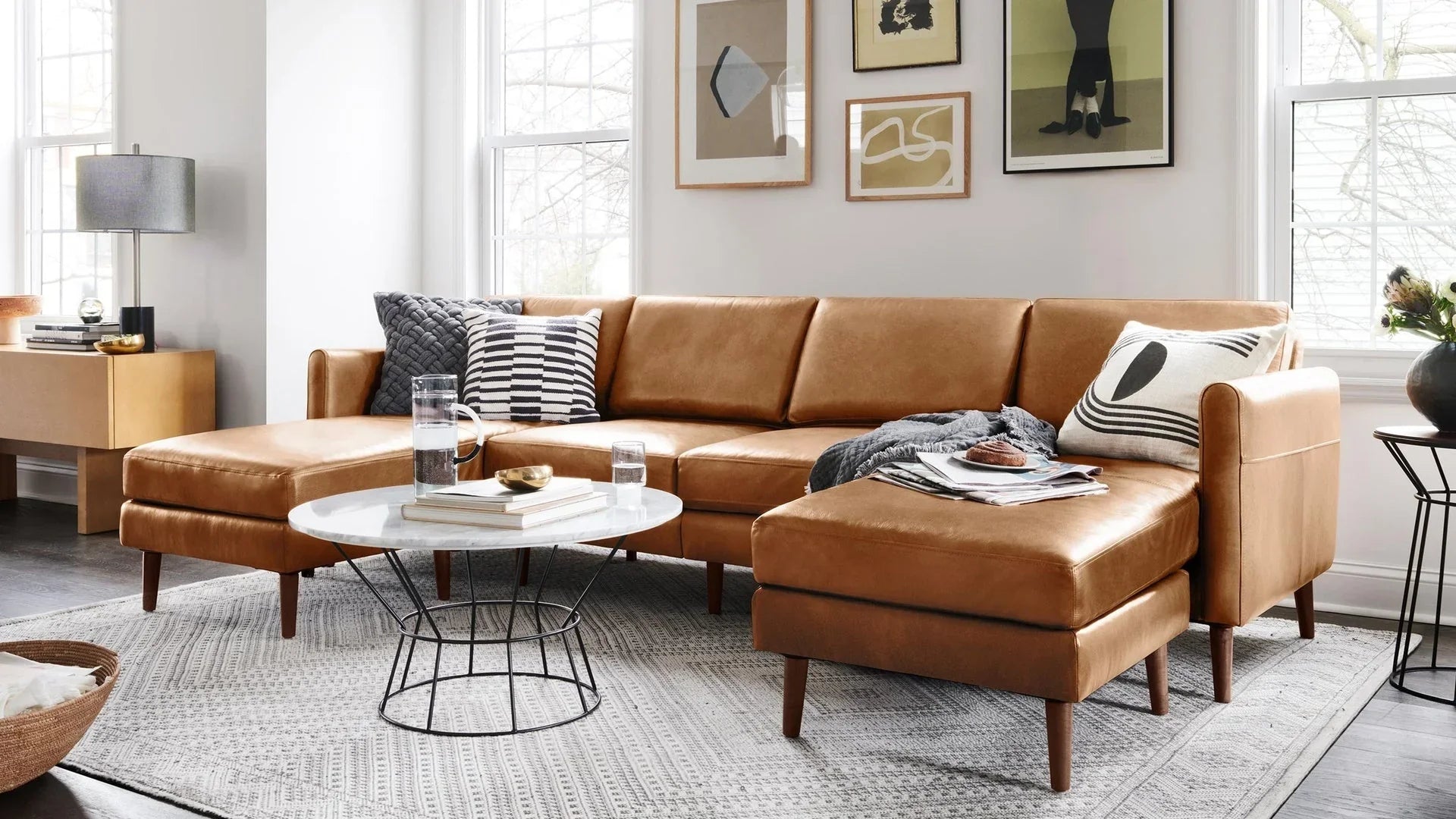
Mid in Mod ships furniture in space-saving boxes, a meaningful advantage for anyone measuring tight entry points. Sectional pieces travel through doorways and stairwells as smaller units rather than a single oversized crate.
Sectionals such as the Harmony Sectional Sofa and the Chamberlain Sectional Sofa arrive broken down into individual sections. Assembly on most models takes five to fifteen minutes with basic hardware like legs or connector brackets — nothing that requires special tools. (Editorial reviewers have echoed how smooth this is: Apartment Therapy tested the Harmony Sectional and highlighted the easy delivery and quick setup.)
A few practical points worth knowing before delivery day:
- Processing and transit. Orders are typically processed within a few business days, with standard transit generally landing in the one-to-two-week range depending on the delivery zone.
- Threshold delivery. The standard service brings furniture to the first dry area of the home — inside the front door or into a garage — without unpacking or assembly.
- White Glove delivery. For a particularly tight staircase, a walk-up apartment, or simply a preference for extra help, a white glove option is available for full-room placement and setup.
- Inspection matters. Check the outer packaging for visible damage before signing, and photograph anything unusual. This protects your ability to file a claim if something arrives damaged.
Taking the doorway and stairwell measurements ahead of time makes the difference between a delivery team walking a sectional piece through a hallway without a second thought — versus a delivery-day surprise.

What if my sofa is a little too wide for the doorway?
Check the diagonal depth against the doorway's diagonal clearance. Many sofas that don't fit straight through can still pass at an angle using the pivot method, provided there's enough ceiling height and turning space on the other side.
Should I measure the door frame or the actual opening?
Always measure the actual clear opening with the door fully open — from the outer door edge to the inner frame edge — rather than the frame's outer dimensions. Door hinges and stops reduce the usable width.
Do sectional sofas need the same measurements as a regular sofa?
Sectionals should be measured piece by piece rather than as one assembled unit, since each section is delivered and carried separately. This is typically what makes a large sectional easier to fit through narrow hallways than a single oversized sofa of similar overall size.
How much clearance should I leave beyond the sofa's exact dimensions?
A margin of two to three inches beyond the narrowest measurement along the delivery path is a reasonable buffer for maneuvering, plus space for the delivery team's hands.
Does an elevator's interior size matter if the door opening is wide enough?
Yes. Check both the door opening and the interior cabin dimensions, since older elevators in particular can have openings that are wider than the usable interior space — or vice versa.
What is the pivot method for getting a couch through a door?
The pivot method means tilting the sofa on its diagonal and rotating it as it passes through the opening. Because the diagonal depth is smaller than the full width, this technique lets a sofa clear a doorway it couldn't fit through flat.
How long does it take to measure a sofa for delivery?
About 15 minutes for a typical home — a few minutes to note the sofa's four dimensions and roughly ten to walk and measure the delivery path from the entrance to the final spot.
Measure Once, Enjoy It the Day It Arrives
Measuring before ordering takes far less time than dealing with a failed delivery, and it means your new sofa is ready to enjoy the moment it arrives — rather than sitting in a hallway waiting for a return label.
Ready to find your piece? Browse the full Mid in Mod sofa collection to compare styles and exact dimensions before measuring day one — and explore our mid-century modern sectionals if you're working with tight stairs or a narrow entry.





Leave a comment
This site is protected by hCaptcha and the hCaptcha Privacy Policy and Terms of Service apply.